
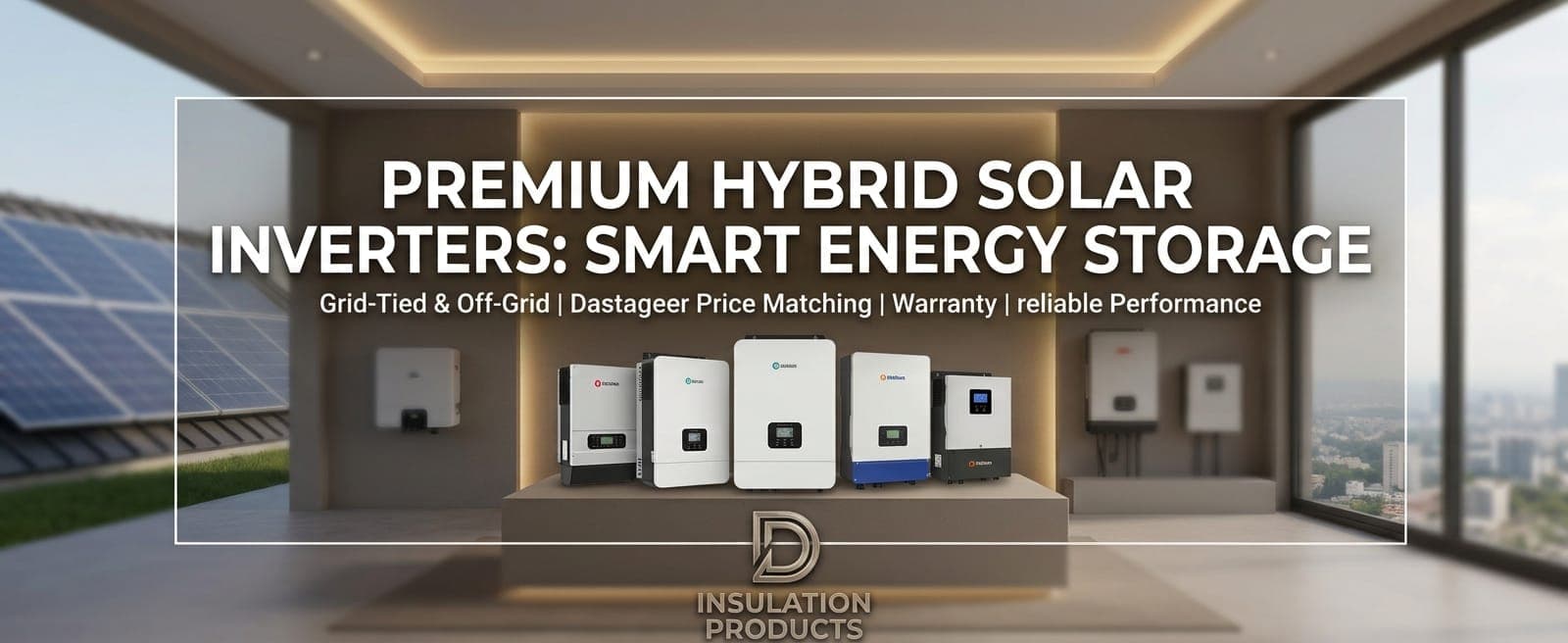
Hybrid Solar Inverters
Solar / Solar Inverter Price in Pakistan / Hybrid Solar Inverters
Hybrid Solar Inverter Price in Pakistan 2026, Complete Guide
If you're choosing a solar inverter in Pakistan today, there's a good chance the answer is hybrid, not because it's the trendy option, but because it's the only inverter type that solves Pakistan's specific problem: high electricity bills combined with daily load shedding. This page explains exactly how a hybrid inverter works, current pricing, and why it's become the default choice for the overwhelming majority of Pakistani buyers. For brand-by-brand pricing, see our Solar Inverter main guide.
What Is a Hybrid Solar Inverter, and How Does It Actually Work?
A hybrid inverter manages three energy sources simultaneously: solar panels, battery storage, and the grid.
Step by step, here is what happens:
Your solar panels generate DC electricity throughout daylight hours
The hybrid inverter converts this DC power into usable AC power for your home
The inverter prioritizes powering your household loads directly, appliances, lights, devices, in real time
Any surplus solar power beyond immediate household needs is automatically directed to charge your battery
Once batteries are full and the home is powered, remaining excess electricity feeds back to the grid through net billing
When the grid fails, the inverter switches to solar and battery power automatically, within milliseconds
This last point is the entire reason hybrid dominates the Pakistani market. An on-grid inverter shuts off completely the moment WAPDA or K-Electric power fails, a safety requirement, not a design flaw, since feeding power into a dead line is genuinely dangerous for utility workers. A hybrid inverter, by contrast, keeps your home running through the outage without interruption.
Why Hybrid Solves Pakistan's Specific Energy Problem
Load shedding in Pakistan is not a seasonal inconvenience, it is a daily operational reality. Urban areas commonly face 4-10 hours of outages per day, while rural areas can see 10-20 hours depending on the local distribution company. This happens despite the national grid carrying substantial surplus generation capacity, the bottleneck is transmission and distribution infrastructure, not total power availability.
Hybrid inverters address both halves of Pakistan's energy problem simultaneously:
High bills: solar generation directly offsets grid consumption during the day
Load shedding: battery-backed automatic switchover keeps essential loads running through outages
This dual-benefit design is why hybrid inverters have effectively overtaken on-grid installations in the Pakistani residential and commercial market in 2026.
Hybrid Inverter Price in Pakistan, 2026
| Capacity | Price Range (PKR) | Best For |
|---|---|---|
| 3-3.5kW | 68,000 – 150,000 | Small apartment, single AC |
| 6kW | 130,000 – 213,000 | Standard home, 1-2 ACs |
| 8kW | 235,000 – 328,000 | Larger home, multiple appliances |
| 10kW | 162,000 – 388,000 | Large home / small commercial |
IP rating matters for price and performance: IP66 outdoor-rated units, better suited to Pakistan's dust, humidity, and heat, typically cost more than IP21 indoor-rated units but are the more practical choice for rooftop mounting in most Pakistani climates.
For complete brand-by-brand pricing (Growatt, Huawei, Inverex, Knox), see our Solar Inverter main guide.
Switchover Speed, A Detail That Actually Matters
Not all hybrid inverters switch to battery power at the same speed during a grid failure, and the difference is noticeable for sensitive electronics:
Fast IP66 hybrid units: switch in under 4 milliseconds, genuinely imperceptible to most users
Standard IP21 indoor units: switch in 10-20 milliseconds, still fast enough for home appliances (fans, lights, fridges) but can cause a brief flicker or restart on sensitive electronics like computers and routers
Have questions about this?
Chat with us on WhatsApp. We usually reply within minutes.
If you work from home or run equipment that can't tolerate even a momentary interruption, ask specifically about switchover speed when comparing inverter models.
Can a Hybrid Inverter Work Without a Battery?
Yes, most hybrid inverters, including premium models, can operate in battery-less mode. In this configuration, the inverter uses solar power during the day and switches to grid power when solar is insufficient, reducing your monthly bill even without any battery investment.
The trade-off: without a battery, there is no backup during load shedding, you get the bill-reduction benefit but not the outage-protection benefit. This makes battery-less hybrid a genuine "buy now, upgrade later" strategy: purchase the hybrid inverter today for immediate bill savings, then add a battery when budget allows for full backup capability.
Hybrid vs On-Grid, The Real Cost-Benefit Comparison
| Factor | On-Grid | Hybrid |
|---|---|---|
| Upfront cost | Cheaper, PKR 150,000-250,000 less for same panel count | Higher upfront |
| Works during load shedding | No, shuts off completely | Yes, automatic battery switchover |
| Saves on daytime bill | Yes | Yes |
| Eliminates generator/UPS cost | No | Yes, saves PKR 50,000-150,000/year typically |
| Battery addable later | N/A | Yes, buy hybrid now, add battery when ready |
The honest math: for most Pakistani families already spending PKR 3,000-8,000/month on generator fuel or UPS battery replacements, a hybrid inverter's battery premium typically pays back within 2-3 years from those generator/UPS savings alone, before counting any electricity bill reduction on top.
Who genuinely doesn't need hybrid: areas with minimal, reliable grid power and no meaningful load-shedding, a shrinking category in Pakistan, but relevant for some large commercial facilities with stable grid connections that prioritise lowest upfront cost.
Battery Compatibility with Hybrid Inverters
Hybrid inverters are compatible with net billing since they remain grid-connected while also managing battery storage, this is a common point of confusion, as some buyers assume adding a battery disqualifies a system from net billing eligibility. It does not, as long as the inverter itself is a compliant on-grid or hybrid model.
LiFePO4 (lithium iron phosphate) batteries are the recommended battery chemistry for hybrid systems in Pakistan, for their safety profile and long lifespan. See our Lithium Battery guide for the complete lithium vs tubular comparison and current pricing.
MPPT Technology, Why It Matters in Pakistan's Heat
Quality hybrid inverters use MPPT (Maximum Power Point Tracking) controllers, which improve solar panel efficiency by continuously adjusting to real-time temperature and light conditions, genuinely beneficial in Pakistan's hot climate, where panel output varies meaningfully across a hot afternoon versus a cooler morning. MPPT is also more efficient than older PWM (Pulse Width Modulation) technology, and provides more stable power output that protects sensitive electronics from voltage fluctuation.
Related Pages
Order Hybrid Solar Inverter, Nationwide Delivery
WhatsApp: +923025102766
Email: interiorsolutions580@gmail.com
Delivery: 2–7 working days
COD on eligible orders · JazzCash · Easypaisa · Bank Transfer
WhatsApp your monthly electricity bill and load-shedding hours in your area, we recommend the right hybrid inverter capacity and configuration.
Ready to order?
Message us on WhatsApp for pricing, availability, and delivery.
Frequently Asked Questions
A hybrid solar inverter manages three energy sources simultaneously, solar panels, battery storage, and the grid. It converts DC solar power to usable AC electricity, prioritizes powering your home directly, charges the battery with surplus solar, and exports any remaining excess to the grid through net billing. During a grid outage, it automatically switches to battery power within milliseconds, keeping your home running without interruption.